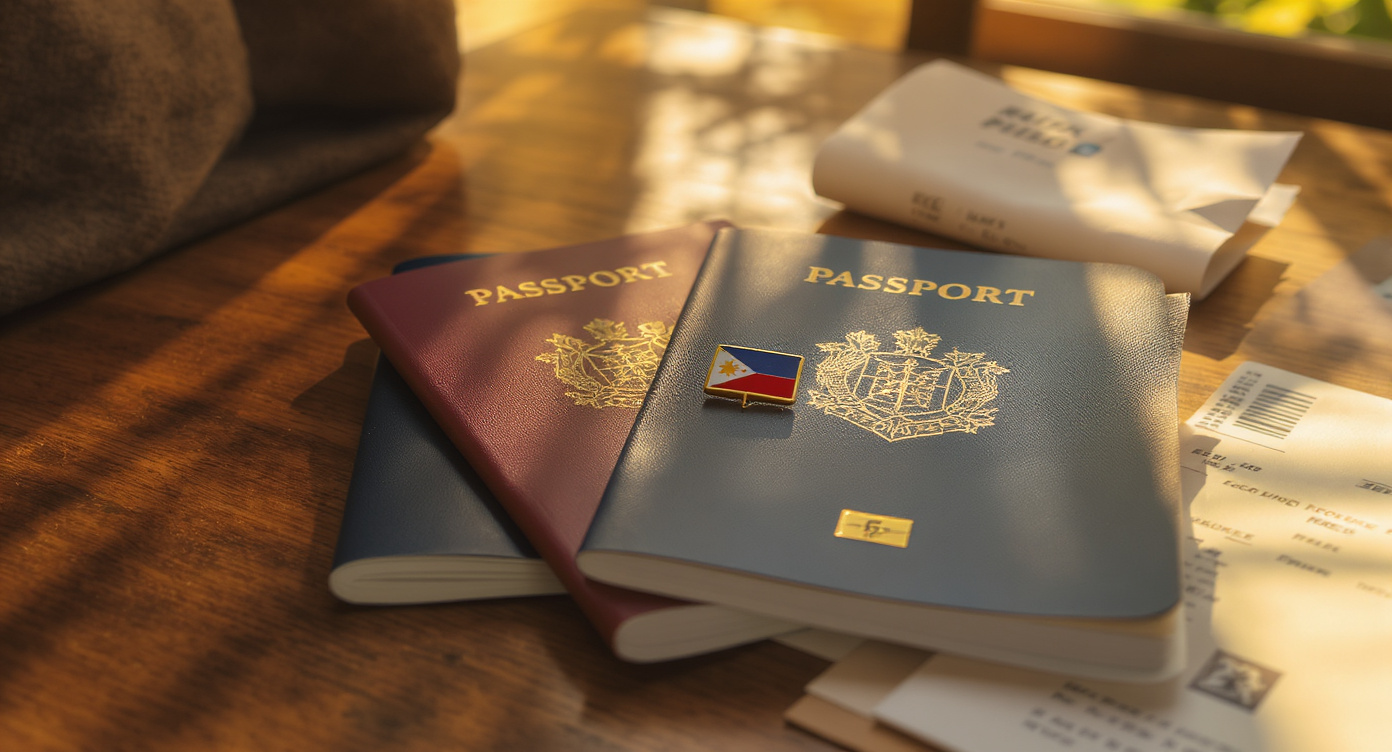
Why Filipino-Americans Should Get Dual Citizenship (It's Easier Than People Think)
I got my dual citizenship at the Philippine Consulate in Los Angeles on a Tuesday morning. I brought my old Philippine passport, my naturalization certificate, two passport photos, and $60 in cash. I walked out forty minutes later a Filipino citizen again. No lawyer. No months of waiting. No drama.
I bring this up because almost every Filipino-American I know assumes this process is some bureaucratic nightmare — weeks of paperwork, a trip to Manila, a fixer. It isn't. And the fact that so many of us assume it's harder than it is means a lot of people are leaving real benefits on the table: property rights, unlimited stays in the country their parents came from, and a genuinely strong financial position if they ever want to split time between the US and the Philippines.
If you're a natural-born Filipino who naturalized as a US citizen, here's the case for doing this, what the process actually looks like, and the one thing you cannot ignore once you do it. (If you were born in the US or elsewhere abroad to a Filipino parent and never naturalized into anything, a different process applies to you — skip to the section below.)
How Easy Dual Citizenship Actually Is
The law is Republic Act No. 9225, the Citizenship Retention and Re-acquisition Act of 2003. It says exactly what it sounds like: if you were a natural-born Filipino and became a US citizen through naturalization, you're deemed to have never lost your Philippine citizenship, once you take an Oath of Allegiance to reactivate it.
You don't give up your US citizenship to do this. The US doesn't require you to renounce anything to hold a second citizenship, and the Philippines, under RA 9225, doesn't either. You end up with two passports, full stop.
Where you apply: Any Philippine consulate or embassy in the US with jurisdiction over where you live — Los Angeles, San Francisco, New York, Chicago, Houston, Honolulu, or the embassy in Washington, DC. You can also file directly at the Bureau of Immigration Main Office if you're in the Philippines when you decide to do this.
What you bring:
- Your old Philippine passport, or a PSA-certified birth certificate showing you were born a Filipino citizen
- Your US naturalization certificate and current US passport
- Two 2x2 photos (specifics vary slightly by consulate, so check the posted checklist)
- Marriage certificate, if your name changed
- The completed petition form, available on the consulate's website
What it costs: Most US consulates charge $50 for the principal applicant and $25 for each minor dependent child included on the same petition, plus small add-ons for certified copies or notarized affidavits if you need them. If you file at the BI Main Office in Manila instead, the published fee is PHP 3,010. Fees change without much notice, so check your specific consulate's page before you go.
What happens: You submit the petition, take the Oath of Allegiance in front of a consular officer, and receive an Order of Approval along with an Identification Certificate confirming your reacquired citizenship. Some consulates process it same-day if you have an appointment; others take a few weeks to mail the certificate. Either way, you're not talking about months of limbo — you're talking about one appointment and some patience for the paperwork to catch up.
Your kids can come along. If you have children under 18 who weren't born Filipino, they can be included as dependents on your petition, or added later through a separate filing, for a smaller fee per child.
If You Were Born Filipino, You Don't Need RA 9225
Everything above is for people who were natural-born Filipino and gave that up by naturalizing as a US citizen. But a lot of Filipino-Americans reading this were never naturalized into anything — they were born Filipino and just don't have the paperwork to show it.
Here's the rule: under the 1987 Constitution, if you were born outside the Philippines on or after January 17, 1973, and either parent was a Filipino citizen at the time you were born, you were a natural-born Filipino citizen from the moment you were born. No oath, no naturalization to reverse, nothing to reacquire. You've been a dual citizen your whole life — the Philippine government just doesn't have a record of it yet.
If that's your kid and they're still young, the fix is simple: file a Report of Birth (Form FA No. 40) at the Philippine embassy or consulate with jurisdiction over where they were born. It runs about $25 in consular fees plus notarization costs, and it registers the birth with the Philippine Statistics Authority so they can get a Philippine passport whenever they need one, without ever touching RA 9225.
If you're an adult who was never registered as a minor, the process is called Recognition as a Filipino Citizen, filed with the Bureau of Immigration in Manila. You petition under oath, and submit your birth certificate, your Filipino parent's birth certificate, and an affidavit from that parent attesting to their citizenship at the time you were born. Once the Bureau of Immigration approves the petition and the Department of Justice confirms it, you still have to report your birth to the consulate with jurisdiction over your birthplace before a passport is on the table. It's more paperwork than the RA 9225 route above, mostly because you're documenting something that should have been on file since birth, not asking the government to give you back something you lost.
Either way, everything below — land ownership, no stay limits, PhilHealth, cheaper school for your kids — applies to you exactly the same as it does to someone who went through RA 9225. You just skip the Oath of Allegiance, because you never lost the citizenship you're claiming.
What You Actually Get
This is the part people underestimate. Reacquiring your citizenship isn't a formality — it changes your legal status in the Philippines in ways that matter if you ever want to buy, stay, or retire there.
You Can Own Land, Not Just a Condo
Foreigners cannot own land in the Philippines. Full stop, no workaround — it's in the 1987 Constitution. A foreign national can buy a condo unit (as long as foreign ownership in that building stays under 40%), but the house-and-lot you actually want, the beach property, the family land your grandparents left behind — none of that is available to you as a US citizen holding a US passport.
The moment you reacquire Philippine citizenship, that restriction disappears. You're legally a Filipino citizen again, which means you can buy land, inherit it cleanly, put it in your own name, and pass it to your kids without the workarounds foreign spouses usually need (corporate structures, long-term leases, putting the title in a Filipino relative's name and hoping that works out).
No Stay Limits, Ever
Here's where the difference between the available options gets concrete:
| Status | Stay Limit | Renewal Required |
|---|---|---|
| Tourist visa (US passport) | 30 days, extendable to 36 months total | Yes, every 60 days at the Bureau of Immigration |
| Balikbayan privilege (former Filipino, foreign passport) | 1 year per entry | Yes, on every re-entry |
| SRRV (retiree visa) | Indefinite, with a $15,000–$50,000 Classic deposit (varies by age/pension; Courtesy lower for some) | Annual PRA membership fee (~$360 Classic) |
| Dual citizen (RA 9225) | Indefinite | None |
As a dual citizen, you enter on your Philippine passport and there's no clock running. No extension fees, no BI visits every couple of months, no deposit tied up to qualify for a retiree visa. You come and go exactly like any other Filipino citizen, because you are one. If you're the kind of person who wants the option to live in the Philippines for six months, or two years, or permanently, without ever thinking about visa status again, this is the whole ballgame.
PhilHealth and Senior Citizen Benefits
Once you're 60, being a Filipino citizen (dual citizenship counts, provided you can show proof and have at least six months of Philippine residency) qualifies you for the Senior Citizen ID from your local OSCA office. That gets you a 20% discount and VAT exemption on medicine, medical services, restaurants, and transportation, plus mandatory PhilHealth coverage under the senior citizen category — funded through the sin tax, not out of your pocket.
None of this is available to you on a US passport alone. Foreign retirees on an SRRV get some healthcare access through private insurance requirements, but the senior citizen discount card specifically is tied to Filipino citizenship. If you're planning to retire in the Philippines eventually, this alone is worth the $50 consulate fee many times over.

Cheaper Education for Your Kids
This one doesn't come up enough. If you ever send your kids to school in the Philippines — a semester, a full degree, or everything from kindergarten on — being a Filipino citizen changes the math and cuts through a pile of immigration paperwork you'd otherwise be stuck with.
Start with the immigration side. A foreign child enrolling in Philippine basic education needs a Special Study Permit from the Bureau of Immigration, renewed every year, currently around ₱5,240 plus a $50 ACR I-Card fee. The school also has to be BI-accredited to accept foreign nationals in the first place, and a regulation caps foreign enrollment at one-third of the student body at any school — so not every school your kid might want to attend can even take them. None of that applies to your kids if they're Filipino citizens. They enroll exactly like any other Filipino kid, at any school, no permit, no renewal, no cap.
Then there's tuition itself. Under RA 10931, the Universal Access to Quality Tertiary Education Act, Filipino citizens get free tuition and 13 other school fees at state universities and colleges — University of the Philippines, Polytechnic University of the Philippines, and dozens of others — as long as they meet admission and retention requirements. Foreign students don't qualify for this automatically. At UP Diliman specifically, foreign undergrads pay per-unit tuition on top of an Educational Development Fund charge of $150–$300 that Filipino citizens never see on their bill. Even at private universities like Ateneo, where tuition itself doesn't change by citizenship, the application fee does: ₱600 for a local applicant versus ₱2,500 for an international one, and Ateneo's own admissions checklist treats dual citizens as local applicants, not international ones, as long as you can show your Certificate of Re-Acquisition.
Zoom out and the bigger number is the one that actually matters: a private university education in the Philippines runs somewhere around $4,000–5,000 a year all-in — tuition, fees, everything. The average US private university sticker price is $45,000 a year in tuition and fees alone, and even after financial aid, students still net out around $17,000 a year on average. Send a kid to college in the Philippines and you're looking at a fraction of either number, and with dual citizenship, that fraction gets smaller still, or drops to zero at a state school.
I know a few Filipino-American families who send their kids to live with grandparents in Manila or Cebu for a year of high school, partly for the culture and the language, partly because it's genuinely cheaper than a year of US private school tuition. Dual citizenship is what makes that a paperwork-free decision instead of a visa-and-permit project.
The US-PH Combo Is Genuinely Unbeatable
This is the part that doesn't show up in the legal breakdowns but matters more than any of them: holding both citizenships gives you the best financial arbitrage available to almost anyone in either country.
You keep full access to the US job market, US-denominated income, and a US passport that opens 179 countries visa-free. Nothing about reacquiring Philippine citizenship touches your American career, your Social Security accrual, or your ability to work anywhere a US passport gets you in the door. Add Philippine citizenship on top and you get a place where that same US income goes dramatically further — rent in Cebu or Davao runs a fraction of a US city, healthcare costs are a fraction of US healthcare costs, and you're not fighting a visa clock to stay there as long as you want.
I know software engineers making US salaries who split their year between a US home base and a condo in BGC, and retirees living entirely on Social Security who are more comfortable in Dumaguete than they ever were in the US on the same check. Both groups are running the same play: American earning power, Philippine cost of living, and dual citizenship removing every piece of friction in between.
The Philippines as Your Low-Cost-of-Living Backup Plan
Nobody wants to think about this scenario, but: if you get laid off, if a recession hits, if US healthcare costs blow up your budget, having a place where your dollar (or your savings) stretches three to five times further is a real safety net. A $1,500/month budget is tight in most of the US. In Cebu or Iloilo, it covers a decent apartment, groceries, eating out, and healthcare with room to spare.
You don't need dual citizenship to visit the Philippines during a rough patch — your US passport gets you 30 days visa-free, extendable. But if the "rough patch" turns into a year, or five years, dual citizenship is what lets you stay there without babysitting a visa, buy a place instead of renting indefinitely, and access PhilHealth and senior benefits if you're old enough to need them. It's the difference between the Philippines being a place you can visit during a crisis and a place you can actually live in during one.
The Best Base for Exploring Southeast Asia
Manila, Cebu, and Clark all have direct or one-stop flights to Bangkok, Ho Chi Minh City, Kuala Lumpur, Singapore, and Bali, most of them under four hours and often under $150 round trip on budget carriers like AirAsia, Cebu Pacific, or Scoot. If you get restless with the Philippines after a few months, you're not stuck — you're one cheap flight from an entirely different country, with the Philippines as the home base you keep coming back to.
The Philippine passport is not the stronger travel document overall. It ranked 72nd globally in the July 2026 Henley Passport Index, with visa-free access to 65 destinations — well behind the US passport's 179. For most of the region you'll still fly on the US book: Thailand, Malaysia, Singapore, and most of Southeast Asia already treat a US passport well.
That said, the Philippine passport does open a few doors the US one currently doesn't, and those doors are worth knowing about.
Where the Philippine Passport Actually Helps
These lists change constantly — a country that lets you in visa-free this year can flip the rule next year — so treat this as a snapshot, not a forever list. As of September 2026, six stand out, and five of them are your immediate neighbors.
Vietnam, Indonesia, Cambodia, Laos, and Myanmar — visa-free under ASEAN reciprocity, paid visa for the US book. This is the one most people miss entirely. As a fellow ASEAN member, the Philippines gets free visa-free entry to other member states that the US, sitting outside the bloc, simply doesn't get:
| Country | Philippine passport | US passport |
|---|---|---|
| Vietnam | Visa-free, 21 days, no fee | Paid e-visa required, ~$25 |
| Indonesia | Visa-free, 30 days, no fee | Paid e-VOA, ~$35, 30 days |
| Cambodia | Visa-free, 21 days, no fee | Paid e-visa required, $30–80, no exemption |
| Laos | Visa-free, 30 days, no fee | Paid e-visa ( |
| Myanmar | Visa-free, 14 days (Yangon, Mandalay, or Naypyidaw only) | Paid e-visa required, no exemption |
I've flown into Bali on my Philippine passport while a planeload of Americans in front of me queued at the e-VOA counter paying $35 a head. Same flight, same beach, different line. It's a small thing until you're doing it four times a year. Vietnam works the same way — a long weekend in Hanoi or a couple of weeks in Da Nang is a walk-up at the airport on the PH book, no e-visa application first.
Brazil, 90 days visa-free. This is the one that actually surprises people. The Brazilian Embassy in Manila confirms that Philippine passport holders can visit Brazil visa-free for up to 90 days. US passport holders, as of April 10, 2025, cannot — they need a visitor eVisa through Brazil's VFS portal, currently $80.90, before they fly. If Rio or São Paulo is on your list, the Philippine passport is the one you present at check-in.
That's the whole dual-passport play: you enter the Philippines on the Philippine book so there's no stay clock, and you pick whichever passport is stronger for the next country. Most of the time that's the US one. Sometimes — the rest of ASEAN, plus Brazil — it's the other way around. Check both before you book.
What to Keep in Mind: You Still Owe the IRS
This is the part I won't let you skip past. Getting Philippine citizenship back does not change your US tax obligations in any way. The United States taxes citizens on worldwide income no matter where they live or what other passports they hold, and that doesn't stop until you renounce US citizenship — which almost nobody reading this should do, given everything above.
What stays exactly the same:
- You file a US tax return (Form 1040) every year, reporting worldwide income, for as long as you're a US citizen
- If your foreign accounts — Philippine bank accounts, GCash, anything — exceed $10,000 at any point in the year, you file FinCEN Form 114 (FBAR). Willful non-filing penalties go up to $100,000 or 50% of the account balance, so this isn't optional
- FATCA Form 8938 has higher thresholds if you live abroad: for US residents it's generally $50,000 / $100,000 (single / married filing jointly) at year-end; if you live outside the US, the year-end thresholds are $200,000 / $400,000 (or $300,000 / $600,000 at any point during the year). Check the IRS Form 8938 page for the table that matches your situation
- The Foreign Earned Income Exclusion lets you exclude up to $132,900 of foreign-earned income for the 2026 tax year if you qualify under the physical presence or bona fide residence test — but this only applies to earned income, not pensions, Social Security, or investment returns
Here's the piece that actually works in your favor: the Philippines only taxes non-resident citizens on Philippine-sourced income. If you qualify as a non-resident citizen under the National Internal Revenue Code — meaning you live and work abroad most of the year — your foreign-sourced income (your US salary, for instance) isn't subject to Philippine income tax at all. You're not paying two governments on the same dollar. You're just still filing with the IRS, forever, the way every US citizen already does.
Talk to a CPA who handles expat returns before you start splitting time between countries in any serious way. The dual citizenship part is genuinely simple. The tax filing part is where people get burned, and it has nothing to do with whether you reacquire your Philippine citizenship — you owe the IRS this either way.
Frank's Take
I'd tell almost every Filipino-American to do this, and the main reason people don't isn't a good reason — it's that they assume it's harder or more expensive than it is. It's not. It's a $50-60 fee and one morning at a consulate you can probably drive to.
The exception is if you're dead certain you'll never live in, retire in, or own property in the Philippines, and you don't have kids who might want that option later. Even then, I'd probably still do it, because the downside is close to zero and the upside — land ownership, unlimited stays, cheaper school for the kids, a real fallback plan, and a couple of visa-free destinations the US passport currently doesn't get you — is significant. The only people who should think twice are those with active legal or financial complications in the Philippines (unresolved estate disputes, tax issues under a previous identity) where reactivating citizenship could reopen something. That's a small group. For everyone else, I don't see the argument against it.
FAQ
Do I lose my US citizenship if I reacquire Philippine citizenship? No. The US permits dual citizenship, and RA 9225 was written specifically so former Filipinos don't have to renounce their new citizenship to get their Philippine citizenship back.
Can I vote in Philippine elections as a dual citizen? Yes, through overseas absentee voting, once you register with the Commission on Elections. You do not need to be physically present in the Philippines to vote.
Does dual citizenship affect my Social Security or US pension? No. Reacquiring Philippine citizenship has no bearing on Social Security, US pensions, or any US government benefit. Those are tied to your US citizenship and work history, not your other citizenships.
Can my US-born children get Philippine citizenship through me? Yes. If you reacquire your citizenship under RA 9225, your minor children can be included on your petition or added afterward as dependents, provided the required documents are submitted.
How long does the whole process take? The appointment itself takes under an hour at most consulates. Getting your Identification Certificate back can take anywhere from same-day to a few weeks, depending on the post and how busy it is.
Enjoyed this article?
Get the latest expat guides and Philippines insights delivered to your inbox.