Getting Around the Philippines
Last updated:
Overview
Getting around the Philippines is easy in some ways and genuinely frustrating in others. The inter-island flight network is good. Grab works reliably in major cities. Domestic ferries cover routes that flights don't reach. But Manila traffic is among the worst I've experienced anywhere in the world — and I've spent time in Bangkok, Jakarta, and Ho Chi Minh City. The key is knowing which mode of transport to use where, and not forcing the wrong one.
This guide covers everything: daily city transport, driving, motorcycles, inter-island flights, ferries, and buses. What I use, what I avoid, and why.
The Basics
The Philippines is an archipelago of 7,600+ islands, which means transportation involves two entirely separate challenges: getting around within a city, and getting between cities and islands.
Within cities, your options are Grab (ride-hailing), jeepneys, tricycles, and walking. Some cities have bus rapid transit (EDSA Busway in Manila, Cebu BRT) and rail (MRT/LRT in Metro Manila). Between islands: flights are fast and cheap, ferries are slow and scenic, and inter-city buses cover Luzon land routes well.
Prices in this guide are in PHP with USD equivalents at PHP 56 to $1.
How It Works in the Philippines
The Philippines does not have the unified public transport app or Oyster-card-style systems you might know from Singapore or Hong Kong. Every mode is separate. You'll pay cash for jeepneys and tricycles. You'll use the Grab app for ride-hailing. You'll book flights on Cebu Pacific or Philippine Airlines' websites or apps. You'll buy ferry tickets at the terminal or through 2GO's website.
Traffic culture here is assertive. Lanes are suggestions in many areas. Motorcycles filter through gaps that seem impossible. Pedestrian crossings are marked but not always respected by drivers. Knowing this going in reduces frustration.
What You'll Need
- Grab app installed and set up with a payment method (credit card or GCash)
- Cash — jeepneys, tricycles, and many buses don't accept cards
- Valid passport or Philippine ID for domestic flights and ferry tickets
- Foreign driver's license if you plan to drive — valid for 90 days from arrival
- Philippine driver's license for longer stays (details in Step by Step below)
Step by Step
Jeepneys
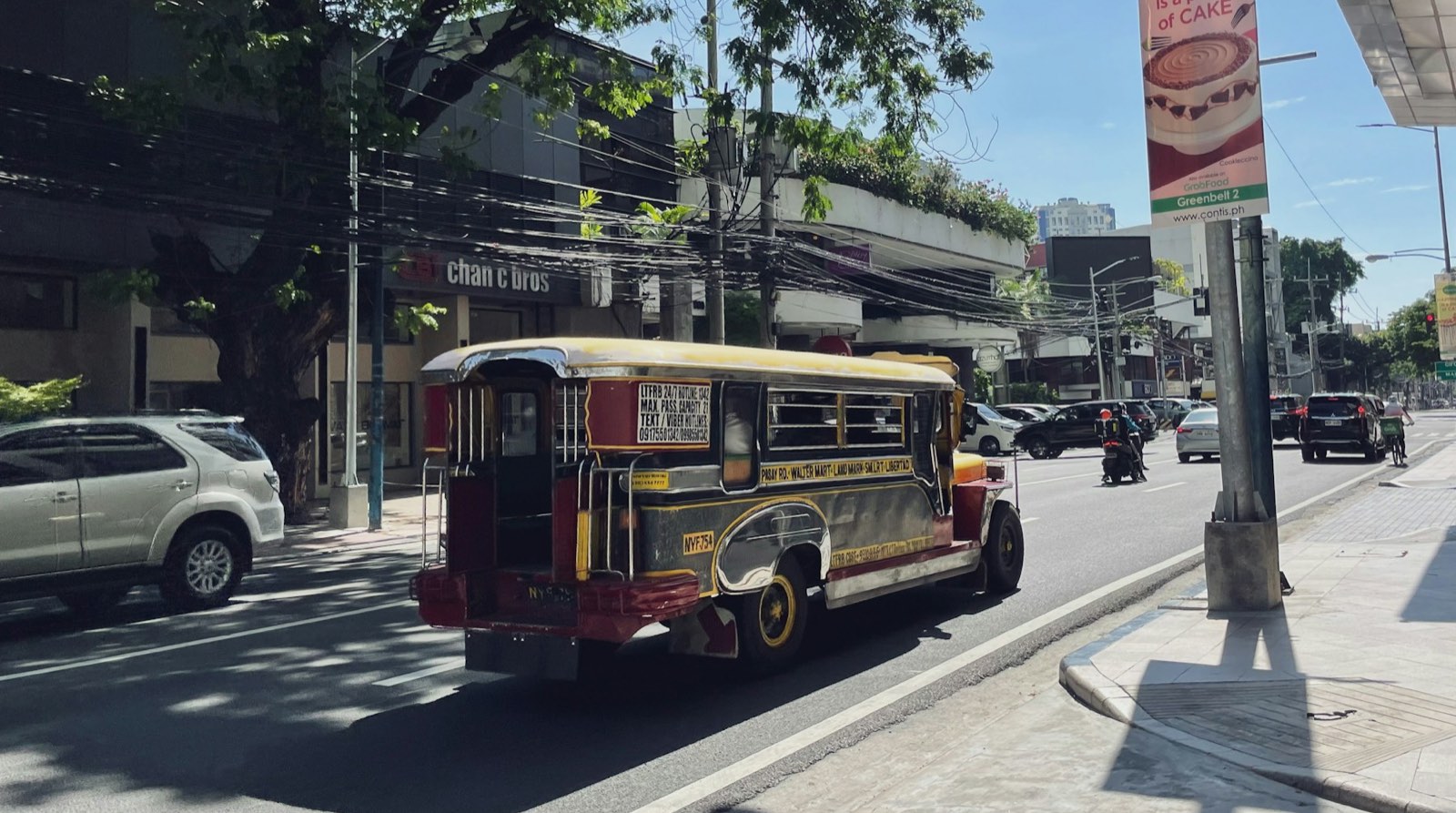
The jeepney is the most Filipino thing in the Philippines. Originally built from leftover US military jeeps after World War II, they're now manufactured locally — elongated, garishly decorated, iconic. Fares are PHP 10–13 for the first 4 km, plus PHP 1.50 per additional km. Cheap.
The catch for newcomers: routes are not well signed. There's no official app with real-time jeepney locations. You learn jeepney routes by experience or by asking. When in doubt, flag one down and ask the driver "going to [destination]?" before boarding. Most drivers will tell you honestly if they pass near where you want to go.
The government has been modernizing the fleet with eJeepneys — electric, air-conditioned, more expensive (PHP 15–20 base fare). They run on the same routes but are easier to identify and ride.
Grab
Grab is the dominant ride-hailing service in the Philippines. It operates in Metro Manila, Cebu City, Davao City, Iloilo City, Bacolod, Cagayan de Oro, and Zamboanga. Outside those cities: no Grab. Set up the app before you need it.
Prices are reasonable. Makati to BGC is PHP 80–120. Makati to Quezon City is PHP 200–350. GrabCar is the standard sedan option. GrabShare is the carpooling option — slower but cheaper. GrabFood handles delivery.
Surge pricing happens during rush hour (7–9am, 5–8pm weekdays) and during rain. Heavy rain in Manila triggers surges immediately — everyone abandons walking and opens Grab at the same time. If you need to go somewhere urgently during a downpour, book early or take the MRT.
Tricycles
The tricycle is a motorcycle with a covered sidecar attached. It's the last-mile transport in almost every Philippine city and municipality. Short distances: PHP 20–50. It's not metered — negotiate the price before you get in, or ask a local what the standard fare is for your route.
Tricycles are licensed by the municipality and are only supposed to operate within specific zones. In practice, drivers often go further for a negotiated price. Useful for getting from a residential area to the main road where Grab can pick you up.
Driving
Your foreign driver's license is valid in the Philippines for 90 days from your arrival date. After 90 days, or if you're staying longer term, you need a Philippine license issued by the Land Transportation Office (LTO).
Philippine license conversion process:
- You must have been a Philippine resident for at least 1 month
- Your visa must be valid for at least 120 days remaining
- You need: valid foreign license (not expired), passport with valid visa, proof of Philippine address
- Medical examination at an LTO-accredited clinic (PHP 300–500, same-day results)
- Application at LTO office — bring original documents and photocopies
- Fee: approximately PHP 585–650 for a non-professional license
If you're from a right-hand drive country (UK, Australia, Japan), you'll need to take a practical driving exam. Philippines drives on the right side of the road. If you're from a left-hand drive country (US, Canada, most of Europe), conversion is documentary only — no exam.
My honest take on driving in Manila: don't. Traffic in Metro Manila is legendary. EDSA, the main highway, regularly records average speeds of 8–12 kph during peak hours. What looks like 5 km on a map can take 45 minutes to an hour. Use Grab. Save your sanity.
Outside Metro Manila — Cebu, Davao, Baguio, provincial areas — driving is much more manageable and in some places genuinely pleasant.
Motorcycles
The motorcycle is the practical choice for expats living outside Metro Manila. Honda Click 125i and Yamaha Nmax are the two most popular options — reliable, fuel-efficient, parts are everywhere, mechanics are cheap. Budget PHP 80,000–150,000 ($1,430–2,680) to buy new. Second-hand units are available for PHP 40,000–80,000.
Your car license covers motorcycles in the Philippines — there's no separate motorcycle license category. You do need a license; riding without one is PHP 2,000+ fine and a hazard in the event of an accident.
Wear a helmet. Always. Not just because it's legally required but because Philippine roads have potholes, stray dogs, and other riders who make unexpected moves.
Domestic Flights
The Philippines has an excellent domestic flight network. Cebu Pacific is the budget carrier and covers the widest number of routes. Philippine Airlines (PAL) is the full-service national carrier. AirAsia Philippines covers major routes with competitive pricing.
Key routes: Manila–Cebu, Manila–Davao, Manila–Iloilo, Manila–Bacolod, Manila–Cagayan de Oro, Manila–General Santos, Cebu–Davao. Most one-way tickets range from PHP 1,500–5,000 ($27–89) if booked 2–4 weeks in advance. Last-minute can spike to PHP 8,000–15,000.
Book directly on the airline's website or app — third-party booking sites don't save you money and complicate rebooking. Cebu Pacific's app is functional and handles seat selection, baggage, and check-in.
NAIA (Ninoy Aquino International Airport) has four terminals that are not connected to each other — confirm your terminal before heading to the airport. Cebu Pacific and PAL both operate out of NAIA Terminal 3, but double-check your ticket.
Ferries
2GO Travel is the main long-distance ferry operator, running routes like Manila to Cebu, Manila to Cagayan de Oro, and Manila to Zamboanga. Starlite Ferries covers Manila to Calapan (Mindoro). Montenegro Lines operates between Batangas and Caticlan (for Boracay). FastCat serves short inter-island routes.
Ferry classes: Tourist (airconditioned dormitory-style), Economy Cabin (shared cabin with bunks), and First Class Cabin (private). Long overnight routes (Manila–Cebu is 20+ hours) have decent cabin options with meals available.
Honestly: for Manila–Cebu, fly. The ferry is under PHP 1,000 cheaper and costs you an entire day. Where ferries genuinely make sense: Batangas to Caticlan for Boracay (faster than the alternative), Cebu to Bohol (FastCat, 2 hours, cheap), and island-hopping in areas where flights don't go.
Inter-City Buses
For Luzon overland routes, buses are excellent. Victory Liner covers Manila to Baguio, Olongapo, and Vigan. JAC Liner runs to Batangas. Ceres Bus is the dominant carrier in Visayas. Fares are cheap — Manila to Baguio is PHP 500–700 on a deluxe bus.
The TPLEX (Tarlac–Pangasinan–La Union Expressway) and NLEX/SLEX system has reduced overland travel times significantly. Manila to Baguio that used to take 6+ hours is now 4–5 hours on a good day. Still book early on holiday weekends when buses fill up.
Costs
| Mode | Route / Use Case | Approx. Cost |
|---|---|---|
| Jeepney | City route | PHP 13–20 |
| Tricycle | Short local trip | PHP 20–50 |
| Grab (GrabCar) | Makati to BGC | PHP 80–120 |
| Grab (GrabCar) | Makati to QC | PHP 200–350 |
| MRT/LRT (Metro Manila) | Any station-to-station | PHP 15–35 |
| Bus (inter-city) | Manila to Baguio | PHP 500–700 |
| Domestic flight | Manila to Cebu (one-way) | PHP 1,500–5,000 |
| Ferry (2GO) | Manila to Cebu, tourist class | PHP 1,800–2,500 |
| Motorcycle (purchase) | Honda Click 125i, new | PHP 80,000–100,000 |
Common Problems & Solutions
Problem: Grab surge during rush hour or rain. Book early if you know you'll be traveling during peak times. Alternatively: walk to a jeepney route, take the MRT if the line serves your route, or wait 20–30 minutes for surge to drop.
Problem: No Grab in smaller cities. Outside major cities, Grab doesn't exist. Tricycles fill this gap. Agree on the fare before you get in. In some cities, motorcycle taxis (habal-habal) operate informally — cheap but unregulated.
Problem: Foreign license expired or past 90-day validity. Go to the LTO. Don't drive on an expired foreign license — if you're in an accident, your insurance likely won't cover you. LTO processing is slow (plan a full day), but the license is valid for several years once issued.
Problem: Domestic flight delays. Philippine domestic flights have a reputation for delays. Cebu Pacific in particular. Factor buffer time into connections. Never book a domestic flight where a delay would cause you to miss an international departure — pad at least 3–4 hours between your last domestic leg and an international departure.
Problem: Getting lost on jeepney routes. Ask the driver or a fellow passenger. Filipinos are consistently helpful with directions. It's also worth downloading Google Maps offline for your city — it shows jeepney routes in Metro Manila with reasonable accuracy.
Recommendations
For Metro Manila daily life: Grab + MRT/LRT + walking. Avoid driving entirely until you've lived there long enough to know the traffic patterns.
For Cebu City: Grab covers the city well. A motorcycle makes sense if you're in the area longer term and want to explore the provincial areas around Cebu.
For Davao City: Relatively manageable traffic. Grab is available. Reasonably easy to drive. Motorcycles popular.
For island-hopping: Fly when available. Ferry for shorter hops (Cebu–Bohol via FastCat is great). The big 2GO overnight ferry is worth doing once for the experience.
Airline choice: Cebu Pacific for budget and widest routes. PAL if you value legroom, luggage allowance, and full meals. AirAsia is fine but I use it less.
More Expat Guides
- ›
Banking for Expats in the Philippines
How to open a bank account, use GCash and Maya, send money internationally, and manage your finances as a foreigner in the Philippines.
- ›
Getting a Philippine Driver's License as a Foreigner
How to convert your foreign driver's license or get a new one in the Philippines — the 120-day rule, LTO requirements, fees, and what the process actually feels like.
- ›
Education and Schools in the Philippines
How to compare school places, curricula, full fees, calendars, and homeschooling options before an expat family moves.
- ›
ECC Exit Clearance: When Foreigners Need It to Leave PH
The Emigration Clearance Certificate explained: who needs it, ECC-A vs ECC-B, timing, and how to avoid getting stopped at the airport.
- ›
First 90 Days in the Philippines: A Moving Budget
Build a realistic Philippines moving budget for your first 90 days, including housing, deposits, monthly costs, visas, and setup.
- ›
GCash for Foreigners: GTourist vs Full Verification
What actually works for foreigners on GCash: the 30-day GTourist route, the resident ID list, real wallet limits, and where each path breaks down.
- ›
Health Insurance in the Philippines for Expats
How expats buy health cover in the Philippines: PhilHealth, local HMOs and international plans, what each layer does and doesn't cover.
- ›
Healthcare in the Philippines
How the Philippine healthcare system works for expats — PhilHealth, private hospitals, insurance options, and what to expect.
- ›
Finding Housing in the Philippines
How to find and rent an apartment or condo as a foreigner — lease terms, deposits, landlord culture, and the best platforms.
- ›
Internet in the Philippines
ISP comparison, speeds, reliability, backup options, and how to get connected as an expat.
- ›
Keeping a US Phone Number Abroad for Bank Verification
How expats in the Philippines keep a US number for bank codes: carrier Wi-Fi calling, Google Voice, NumberBarn, costs, and 2FA backups.
- ›
Retiring in the Philippines: A Readiness Checklist
What has to be true before you retire in the Philippines: visa structure, healthcare that works, income access, housing, and long-term budget lines.
- ›
Safety in the Philippines: What Expats Actually Experience
What the crime data actually says, where risk changes by region, the scams foreigners run into most, and what to do if something happens.
- ›
SafetyWing in the Philippines: A Nomad's Guide to Coverage
Is SafetyWing right for your Philippines stay? Comparing Nomad Insurance Essential and Complete versus local HMOs for digital nomads and remote workers.
- ›
Sending Money to the Philippines: What Actually Arrives
Fees, exchange rates and receiving options compared: what a transfer to a Philippine bank, GCash wallet or cash pickup really delivers.
- ›
Starting a Business in the Philippines as a Foreigner
Foreign ownership rules, SEC registration, the 60-40 rule, and practical steps to launch a business.
- ›
Taxes for Expats in the Philippines
Whether foreign nationals owe Philippine tax, BIR TIN registration, the 180-day rule, 2023 tax brackets, and how US/UK/AU/CA treaties apply.